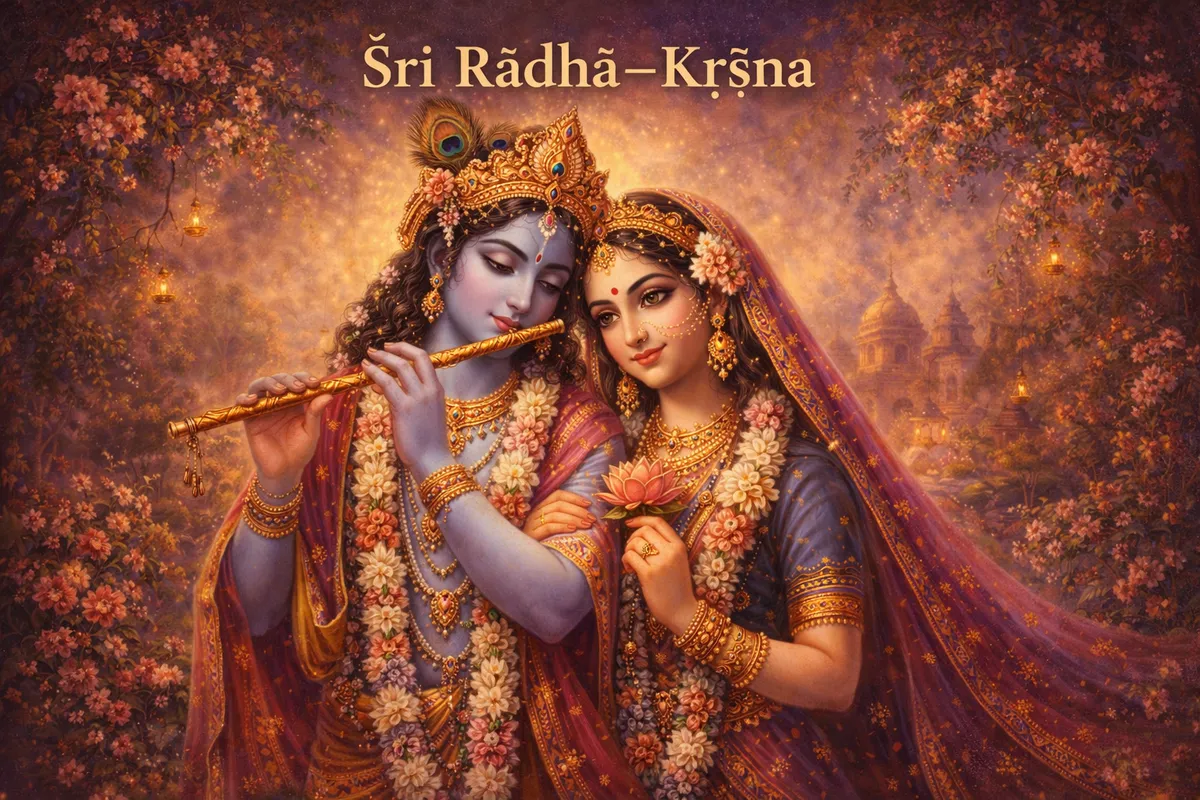
Loading Sacred Knowledge…
Loading Sacred Knowledge…
Experience the Divine Wisdom
Journey into the sacred knowledge that has illuminated humanity for millennia
Discover the four sacred Vedas - Rigveda, Yajurveda, Samaveda, and Atharvaveda. Explore the timeless wisdom that forms the foundation of Vedic knowledge.
Understand the philosophical pinnacle of Vedic thought and the six orthodox systems of Indian philosophy - Nyaya, Vaisheshika, Samkhya, Yoga, Mimamsa, and Vedanta.
Trace the divine origins of Vedic knowledge, revealed through the ancient Rishis in deep meditation and preserved through sacred oral tradition.
Delve into the mystical teachings of the principal Upanishads, which reveal the nature of ultimate reality, Brahman, and the path to self-realization.
Learn about the supreme goddess of divine love, Srimati Radharani, whose pure devotion and eternal relationship with Krishna embodies the highest spiritual love.
Celebrate the appearance day of Srimati Radharani, a sacred festival observed with devotion, fasting, and spiritual ceremonies honoring the Divine Feminine.
Vedagnaan is dedicated to preserving and sharing the eternal wisdom of the Vedas with seekers across the world. In an age of rapid change, the timeless spiritual truths contained in Vedic literature provide guidance, peace, and profound understanding.
Through carefully curated content, authentic translations, and expert commentary, we make ancient Vedic knowledge accessible to modern seekers. Our platform provides:
We envision a world where Vedic wisdom illuminates the path for spiritual seekers, helping humanity reconnect with eternal truths. By bridging ancient knowledge with modern technology, we aim to make these profound teachings available to all sincere souls.
Whether you are beginning your spiritual journey or deepening your existing practice, Vedagnaan welcomes you. Explore our resources, engage with the content, and discover the transformative power of Vedic knowledge.
The four sacred Vedas and their profound teachings
Philosophical systems of Indian thought
Divine revelation and ancient wisdom
Mystical teachings of ultimate reality
The supreme goddess of divine love
Celebrating the appearance of Radharani
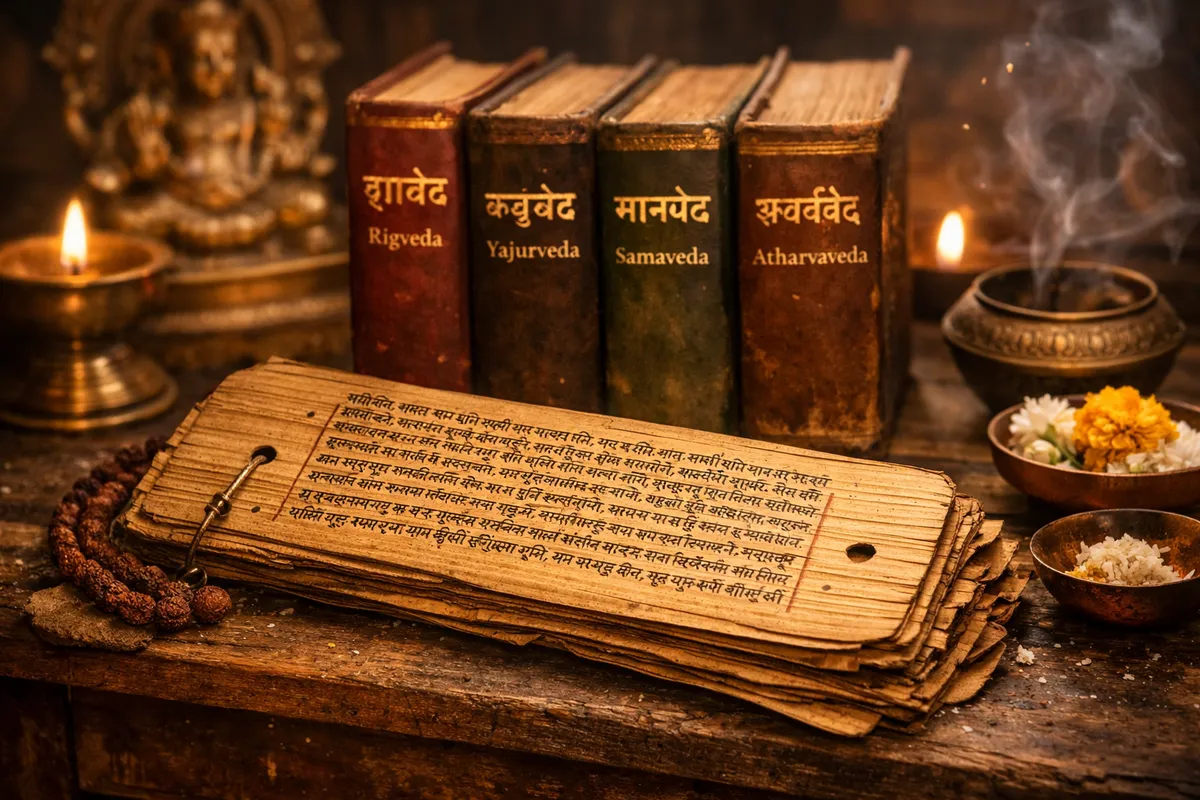
The Vedas are the most ancient scriptures of Hinduism and represent the foundational texts of Indian philosophy and spirituality. The word "Veda" comes from the Sanskrit root "vid," meaning "to know." These sacred texts are considered apauruṣeya (not of human origin) and were revealed to ancient sages through divine inspiration.
Rigveda: The oldest of the Vedas, containing 1,028 hymns dedicated to various deities. These hymns praise natural forces and cosmic principles, revealing profound spiritual truths through poetic verses.
Yajurveda: The book of sacrificial formulas and rituals. It provides detailed instructions for performing yajnas (sacrificial ceremonies) and explains the spiritual significance of these sacred rites.
Samaveda: The Veda of melodies and chants. Most verses are derived from the Rigveda but set to musical notations for liturgical purposes, representing the marriage of sound and spirituality.
Atharvaveda: Contains hymns, spells, and incantations dealing with daily life, healing, and protection. It represents practical spirituality and addresses human concerns with divine wisdom.
Each Veda consists of four parts:
The Vedas represent humanity's earliest recorded quest for understanding the cosmos, consciousness, and the Divine. They contain timeless wisdom on dharma (righteousness), karma (action), moksha (liberation), and the nature of reality itself. Their teachings continue to guide spiritual seekers on the path to enlightenment.
Lecture by Swami Sarvapriyananda explaining the philosophical foundations of the Vedas.
An educational lecture explaining the structure, meaning, and significance of the four Vedas.
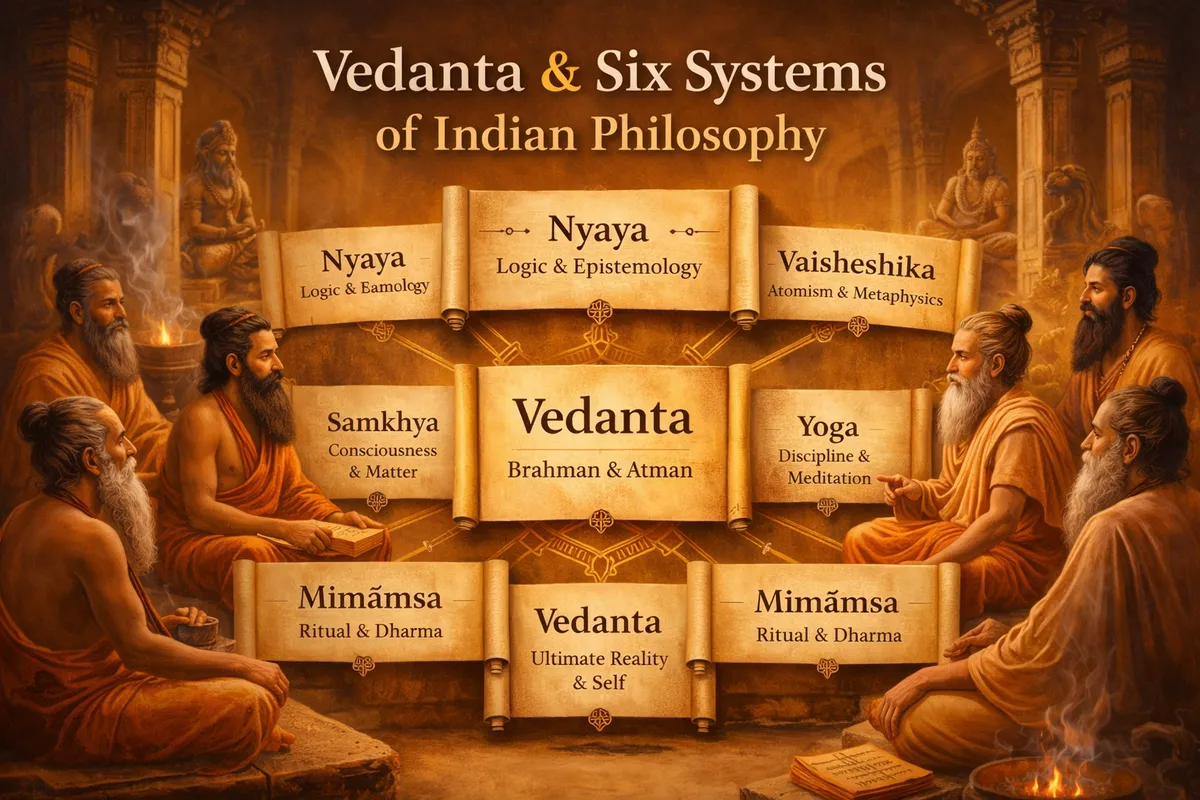
Vedanta is the philosophical culmination of the Vedic tradition. The term literally means “the end of the Vedas” and is rooted primarily in the Upanishads, along with the Brahma Sutras and the Bhagavad Gita. Vedanta explores the deepest questions of existence, consciousness, and liberation.
Central to Vedanta are the concepts of Brahman, the infinite and eternal ultimate reality, and Atman, the inner self. The realization of their true nature leads to Moksha—freedom from the cycle of birth and death.
The Six Systems of Indian philosophy are known as Āstika Darśanas because they accept the authority of the Vedas. Each system offers a unique approach to understanding reality and attaining liberation.
Together, Vedanta and the Six Systems form a complete philosophical framework—uniting logic, ethics, meditation, ritual, and spiritual wisdom. Rather than abstract theories, they offer practical guidance for understanding life, cultivating inner peace, and attaining liberation.
Lecture by Swami Sarvapriyananda explaining the fundamentals of Vedanta philosophy.
An accessible explanation of Brahman, Atman, and the goal of liberation in Vedantic philosophy.
An overview of Nyaya, Vaisheshika, Samkhya, Yoga, Mimamsa, and Vedanta.
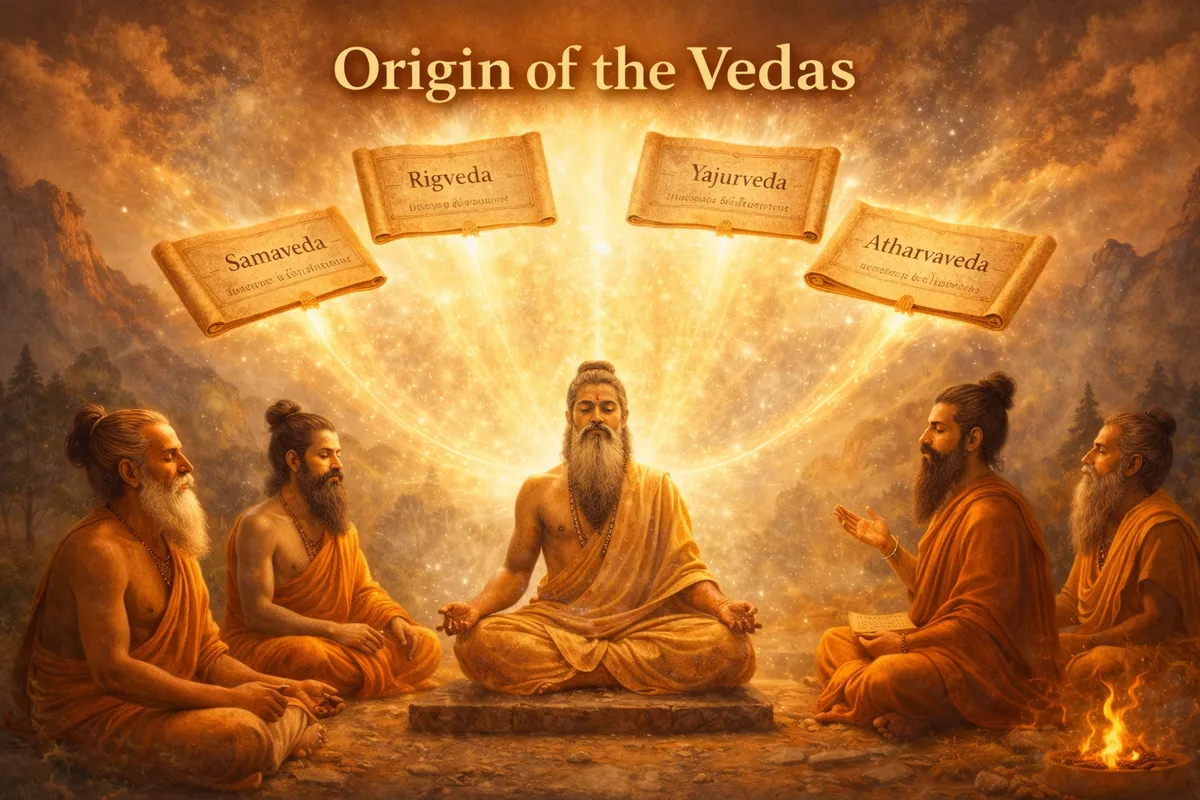
The Vedas are the most ancient and sacred scriptures of Indian civilization and form the spiritual foundation of Hindu philosophy. They are regarded as Apauruṣeya, meaning not authored by any human being, but revealed as eternal truths to enlightened sages.
According to Vedic tradition, the Vedas were not written or composed in the usual sense. Instead, they were heard by great sages known as Rishis during deep meditation. This is why the Vedas are classified as Śruti, meaning “that which is heard.”
For thousands of years, the Vedas were transmitted through an extraordinary oral tradition. Sophisticated methods of chanting and memorization ensured that every syllable, accent, and intonation remained perfectly preserved across generations.
Modern scholars generally date the compilation of the Vedas between 1500 BCE and 500 BCE, during the early Vedic period of ancient India. Traditional belief, however, holds that Vedic knowledge is timeless and eternal.
Sages such as Agastya, Vasishtha, Vishvamitra, Bharadvaja, and Atri are associated with various Vedic hymns. They are honored not as authors, but as seers who revealed cosmic truths for the welfare of humanity.
Although preserved orally for centuries, the vast body of Vedic knowledge was later systematized to ensure its survival. Sage Vedavyasa is traditionally credited with organizing the teachings into four Vedas:
The origin of the Vedas highlights a unique vision of knowledge as sacred, eternal, and universal. The Vedas guide humanity toward truth (Satya), cosmic order (Rta), and liberation (Moksha).
Far beyond historical texts, the Vedas remain a living tradition—continuing to inspire philosophy, spirituality, and self-realization across generations.
Lecture by Swami Sarvapriyananda explaining the fundamentals of Vedanta philosophy.
An accessible explanation of Brahman, Atman, and the goal of liberation in Vedantic philosophy.
An overview of Nyaya, Vaisheshika, Samkhya, Yoga, Mimamsa, and Vedanta.
Access lectures, study resources, and classes on Vedanta philosophy from the Vedanta Society.
Explore sacred Vedic texts including the Upanishads, Bhagavad Gita, and other Vedantic scriptures.
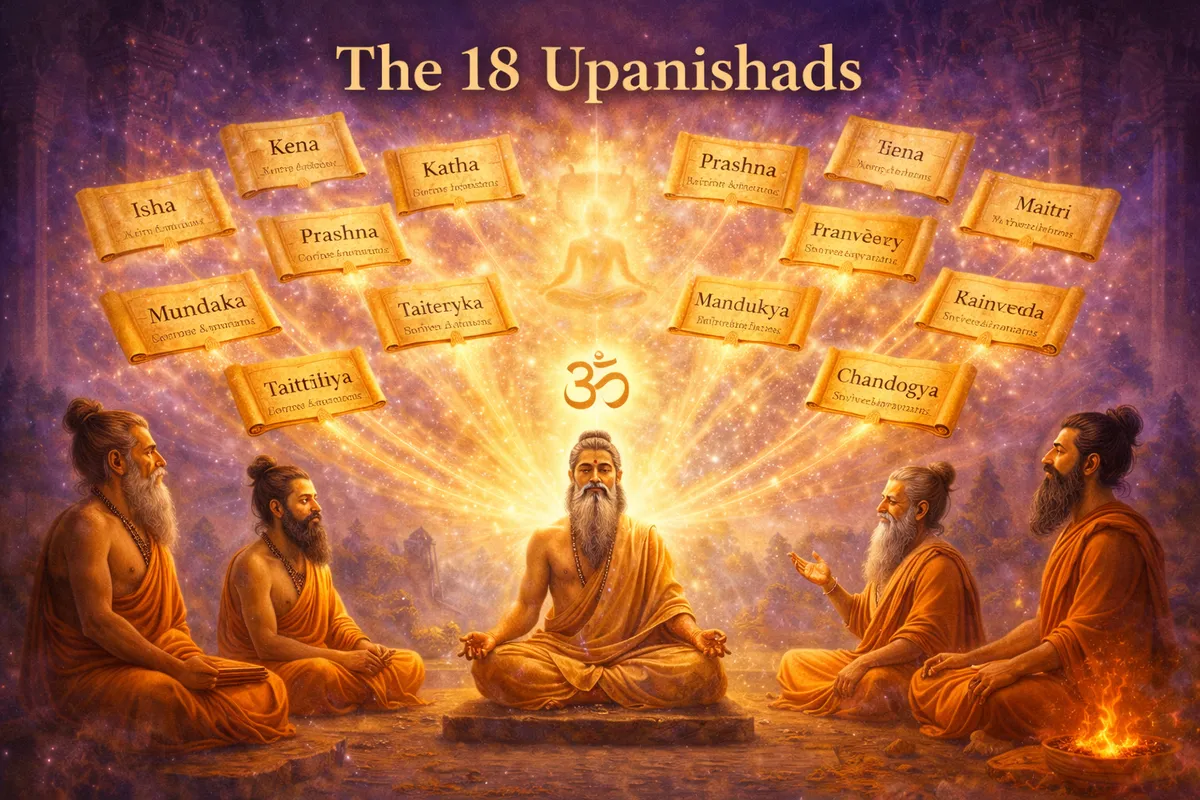
The Upanishads are profound philosophical texts that represent the spiritual and metaphysical essence of the Vedas. They form the concluding portion of the Vedic literature and are therefore regarded as the foundation of Vedanta philosophy.
The word Upanishad literally means “to sit near”, symbolizing the intimate transmission of spiritual wisdom from a teacher (Guru) to a student (Shishya). The Upanishads focus not on rituals, but on inner knowledge and realization.
The Upanishads explore the deepest questions of human existence:
Their central teaching is the unity of Atman (the individual self) and Brahman (the universal absolute). Realizing this truth leads to freedom from ignorance and the cycle of birth and death.
Among more than 100 Upanishads, tradition recognizes 18 principal Upanishads as the most authoritative and influential:
The Upanishads introduced revolutionary ideas such as: Karma (law of action), Samsara (cycle of rebirth), Maya (illusion), and Moksha (liberation).
They emphasize Jnana (knowledge) as the highest means to liberation, surpassing ritual action when performed without understanding.
The Upanishads profoundly influenced Indian philosophy, spirituality, yoga, and meditation. They inspired great teachers such as Adi Shankaracharya and shaped schools of Vedanta.
Even today, their timeless wisdom continues to guide seekers toward self-realization, inner peace, and universal harmony.
Swami Sarvapriyananda explains the spiritual and philosophical teachings of the Upanishads.
An insightful lecture on the Upanishadic ideas of Atman, Brahman, and the nature of consciousness.
A lecture explaining how the Upanishads form the philosophical foundation of Vedanta.
Access lectures, study resources, and classes on Vedanta philosophy from the Vedanta Society.
Explore sacred Vedic texts including the Upanishads, Bhagavad Gita, and other Vedantic scriptures.
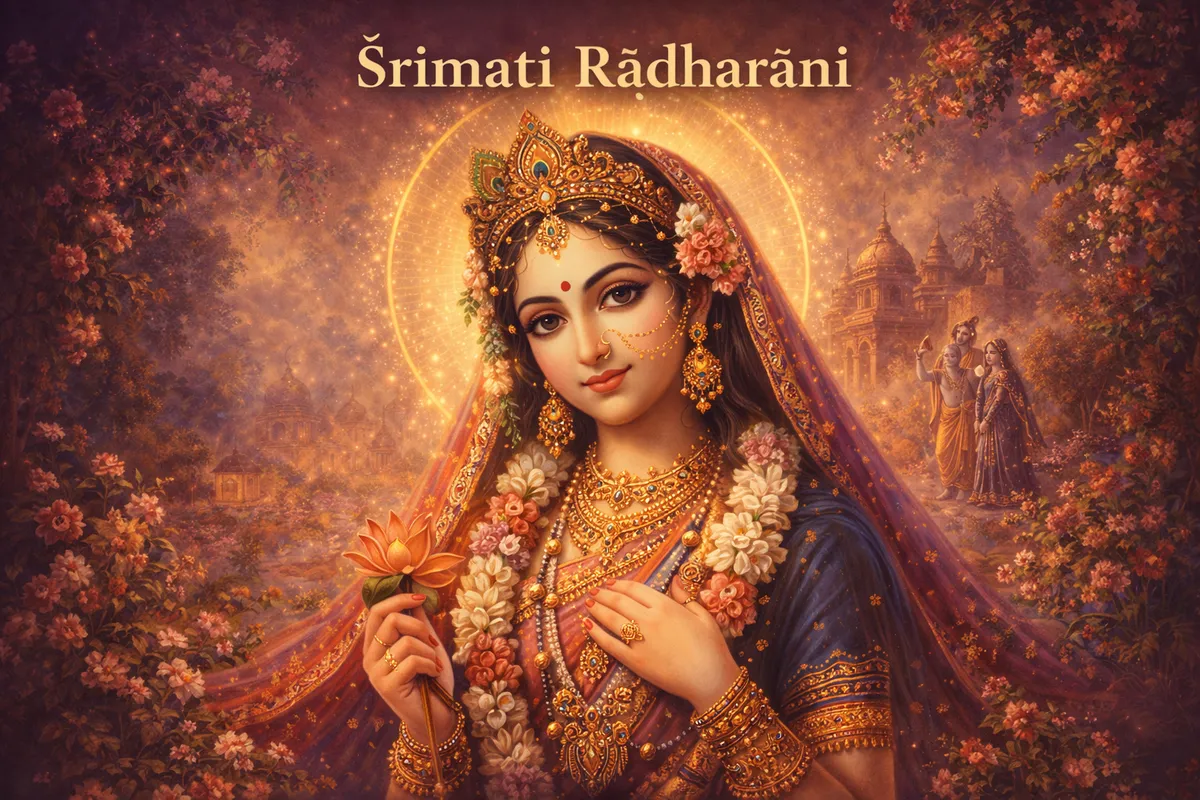
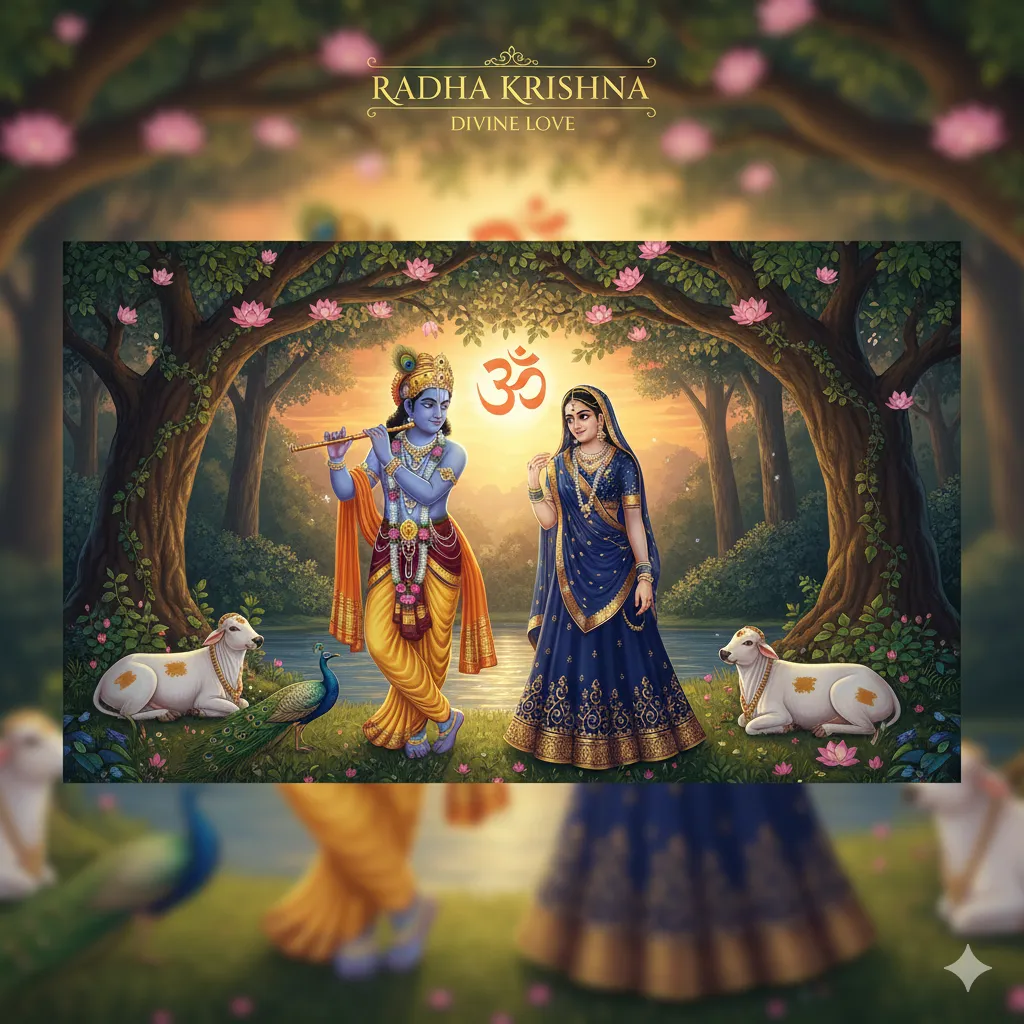
Śrīmatī Rādhārāṇī is revered as the supreme goddess of devotion and the eternal consort of Lord Krishna. She embodies the highest expression of pure love (Prema-Bhakti) and represents the internal pleasure potency (Hlādinī Śakti) of the Supreme Lord.
In the Vaishnava tradition, Rādhārāṇī is not merely a devotee of Krishna, but His eternal counterpart. She is the source of all devotional energy and the personification of selfless love, compassion, and spiritual bliss.
Scriptures describe Her as the very heart of Krishna—inseparable from Him, just as fragrance is inseparable from a flower.
The divine love between Rādhā and Krishna is considered the highest spiritual truth. Their relationship is not worldly romance, but a transcendental exchange symbolizing the soul’s pure love and longing for God.
Rādhārāṇī’s devotion is so complete that even Krishna seeks to understand the depth of Her love. It is said that through Rādhā, one can most easily attain the grace of Krishna.
Śrīmatī Rādhārāṇī teaches humanity the path of:
Devotees believe that sincere prayer to Rādhārāṇī softens the heart and awakens true devotion to Krishna.
Śrīmatī Rādhārāṇī is glorified in texts such as the Bhagavata Purāṇa, Brahma Vaivarta Purāṇa, Gīta Govinda, and the writings of great saints like Rūpa Gosvāmī and Jayadeva.
Śrīmatī Rādhārāṇī is the eternal queen of Vrindavan and the embodiment of divine love. Meditating upon Her lotus feet inspires pure devotion, inner purity, and the highest spiritual fulfillment.
An explanation of the spiritual identity of Srimati Radharani and her role as the supreme goddess of devotion.
A devotional lecture explaining the divine love between Radha and Krishna in Vaishnava tradition.
A spiritual explanation of the transcendental relationship between Radha and Krishna.
Śrī Rādhā–Kṛṣṇa represent the supreme divine couple and the highest expression of spiritual love in the Bhakti tradition. Together, they embody the eternal union of the Supreme Reality and its loving devotional energy.
Lord Kṛṣṇa is the Supreme Personality of Godhead, the source of all creation, while Śrīmatī Rādhārāṇī is His internal pleasure potency (Hlādinī Śakti). Their divine relationship transcends material existence and reveals the deepest truths of love, devotion, and unity.
The love shared between Rādhā and Kṛṣṇa is known as Prema-Bhakti— pure, unconditional devotion free from selfish desire. It symbolizes the soul’s eternal longing for communion with the Divine.
Their pastimes in Vṛndāvana are not ordinary stories but sacred expressions of transcendental truth, teaching that love is the highest path to God.
On a deeper level, Rādhā–Kṛṣṇa represent:
Their eternal togetherness teaches that God is not impersonal alone, but also supremely personal—responsive to love and devotion.
The glory of Śrī Rādhā–Kṛṣṇa is celebrated in sacred texts such as the Bhāgavata Purāṇa, Brahma-Vaivarta Purāṇa, Gīta Govinda, and the devotional writings of the Gosvāmis of Vṛndāvana.
Meditating on Śrī Rādhā–Kṛṣṇa awakens humility, compassion, joy, and inner peace. Their divine love inspires seekers to rise above ego and experience life as a sacred relationship with the Supreme.
Devotees believe that by seeking the grace of Rādhārāṇī, one can easily attain the mercy of Lord Kṛṣṇa.
Śrī Rādhā–Kṛṣṇa are the eternal symbols of divine love and spiritual fulfillment. Remembering Them with devotion purifies the heart and leads the soul toward its highest destiny—loving union with the Divine.
A spiritual explanation of the divine relationship between Radha and Krishna and the meaning of pure devotion.
This episode explores the spiritual love and devotion between Radha and Krishna in Vrindavan. :contentReference[oaicite:0]{index=0}
A depiction of the sacred Raas Leela, symbolizing the highest form of divine love and devotion. :contentReference[oaicite:1]{index=1}
Spiritual wisdom and guidance.
Samaved Shanmukha Sharma | SHANKARA SAMPRADAYA
Devotional songs praising the Divine.
A devotional discourse explaining the divine glory and spiritual significance of Srimati Radharani.
A spiritual explanation of the transcendental relationship between Radha and Krishna.
Devotional narration about the pure love and devotion between Radha and Krishna.
Click corners or drag to flip pages
We are delighted to connect with devotees, spiritual seekers, and anyone interested in Vedic wisdom.
Santhosh Nukalwar
PLOT NO : 68 IKYATHA HOMES, BEERAMGUDA, AMEENPUR,
SANGAREDDY, Hyderabad, Telangana, India, 502032